
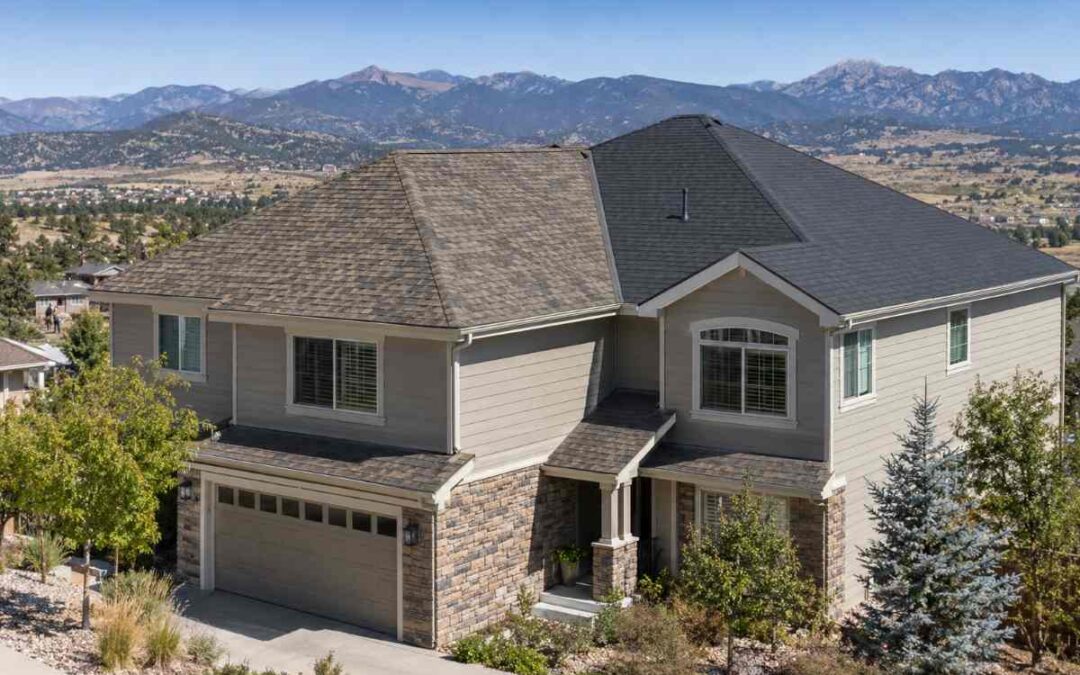
The decision is rarely a free choice. A homeowner standing in the yard after a Front Range hailstorm is really deciding how much of the roof comes off, and how much of that they get to control.
Five things decide it. They rank in a fixed order, and the order is not negotiable. First is whether a building code forces a full replacement, because a code trigger takes the choice out of the owner’s hands entirely. After that comes the deck under the shingles, which can force a tear-off no matter how new the covering is, then the roof’s age, then how far the damage has spread.
Cost ranks last, measured per year of service each option buys. The order matters as much as the list. One trigger can settle the question before cost is ever raised, which is why the 2025 Colorado Wildfire Resiliency Code now sits in the picture for many Castle Rock parcels.
Both sides of the decision run the same five tests, residential and commercial, across Castle Rock and Metro Denver. Hail is usually the event that forces the call, and that is where the pressure starts.
What Decides Whether a Roof Gets Repaired or Replaced?
Replace the roof when a code trigger applies, the deck is compromised, the covering is near the end of its service life, or damage spans multiple slopes. Replace it, too, when repeated repairs cost more per remaining year than a new roof costs per year of service. Repair it when four things hold. Damage is isolated, the deck is sound, service life remains, and no code trigger applies.
Those five tests run in a set order, and the order decides the outcome. A code trigger comes first, because it removes the owner’s choice before any other factor is weighed. Deck condition comes second. Soft, rotted, or delaminated sheathing cannot hold new fasteners, so a bad deck forces a tear-off no matter how the covering looks.
Age against rated life is third, damage extent is fourth, and cost per remaining year breaks the tie only after the first four are settled. A newer roof can still fail if the deck beneath it has gone. That is why deck condition outranks age.
Roofing work comes in four scopes, and each one is defined by what it leaves in place. A spot repair swaps out a few shingles or a flashing. A section or slope replacement redoes one whole plane. A roof recover lays a new covering over the old, while a full tear-off strips everything to the deck and starts over.
The warranty position is what separates those scopes over the long run. A manufacturer system warranty, the kind that covers the covering and its components together, generally requires a full tear-off and a complete new system installed to specification. Repair or recover work does not start one. A tear-off replacement can, because the manufacturer is warranting a system it installed whole.
When Does Colorado Code Require a Full Roof Replacement?
Two code provisions can force a full replacement in Castle Rock. Both outrank cost and owner preference. One is a 2024 International Residential Code limit on laying a new roof over an old one, and the other is the 2025 Colorado Wildfire Resiliency Code rule that turns a large re-roof in a mapped wildfire area into a full Class A replacement.
Can You Put a New Roof Over Old Shingles in Colorado?
An overlay is allowed only when the existing roof has a single layer, is not water-soaked or deteriorated, and is not slate, clay, cement, or asbestos-cement tile. A homeowner gets protection from a hidden-damage recover because 2024 IRC R908.4, the roof-recover section Castle Rock adopted for new permits, bars laying a new covering over the old one in three cases:
- The existing roof or covering is water-soaked or has deteriorated past the point of a sound base.
- The existing covering is slate, clay, cement, or asbestos-cement tile.
- The roof already carries two or more applications of any covering.
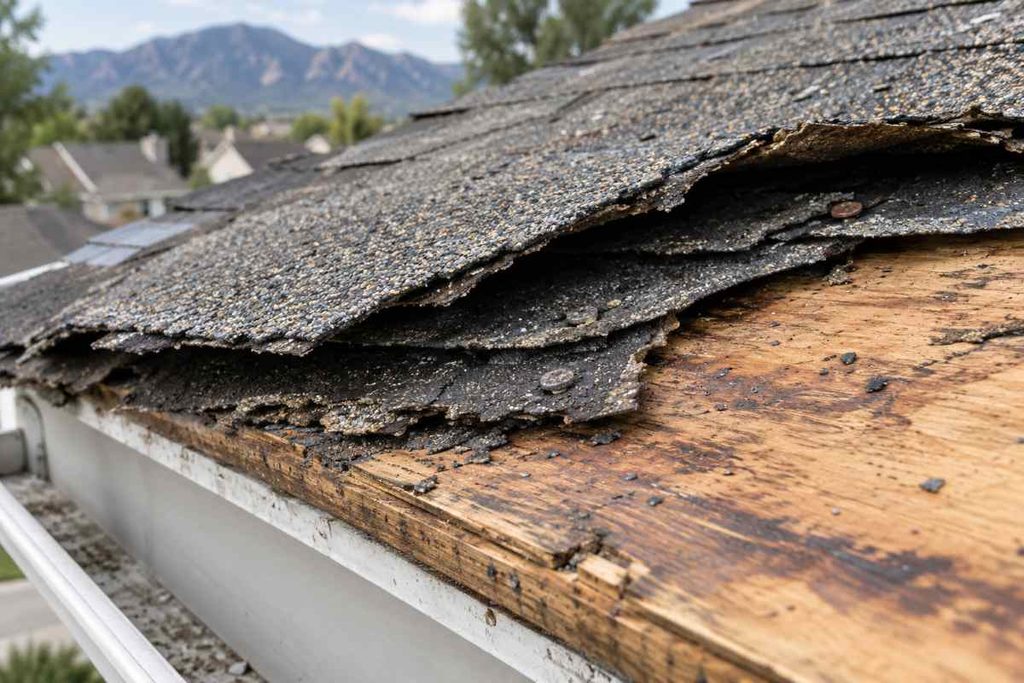
Miss any one of those and the overlay an owner was quoted is not a legal option. The code’s alternative is a replacement. Under 2024 IRC R908.3, that strips every layer down to the roof deck, the one point where the deck gets inspected sheet by sheet. An overlay seals the deck out of sight, so a soft or rotted spot rides along under new shingles until it fails.
What Is the 25 Percent Re-Roof Rule in Castle Rock?
In Castle Rock, replacing, reconstructing, altering, or repairing 25 percent or more of a roof covering on a building that predates the 2025 Colorado Wildfire Resiliency Code forces a full replacement of the entire covering to a Class A standard. The rule took effect July 1, 2026.
The trigger applies only to parcels the Town’s wildfire map shades low, as yellow, or moderate to high, as orange-red. A parcel with no map color carries no upgrade requirement. Where one parcel spans two shades, the most restrictive classification governs the whole parcel.
One condition holds across every hazard class. Once the work reaches 25 percent of the roof surface, a re-roof permit is required no matter how the parcel is mapped.
The replacement covering must be rated Class A under the Code’s Section 403.2, the top fire classification, tested to ASTM E108 against flame spread and burning-brand exposure. A profiled covering such as tile leaves a gap above the deck. That gap has to be closed against flame and ember entry, either by firestopping it or by laying a cap sheet over the deck first. A cap sheet is a reinforced asphalt base layer.
Valleys carry their own rule, because they funnel debris and embers downslope. The Code requires corrosion-resistant metal flashing at least 0.019 inches thick, the equivalent of No. 26 galvanized sheet gage, run over a 36-inch cap sheet the full length of the valley.
When Does Roof Deck Damage Require a Full Replacement?
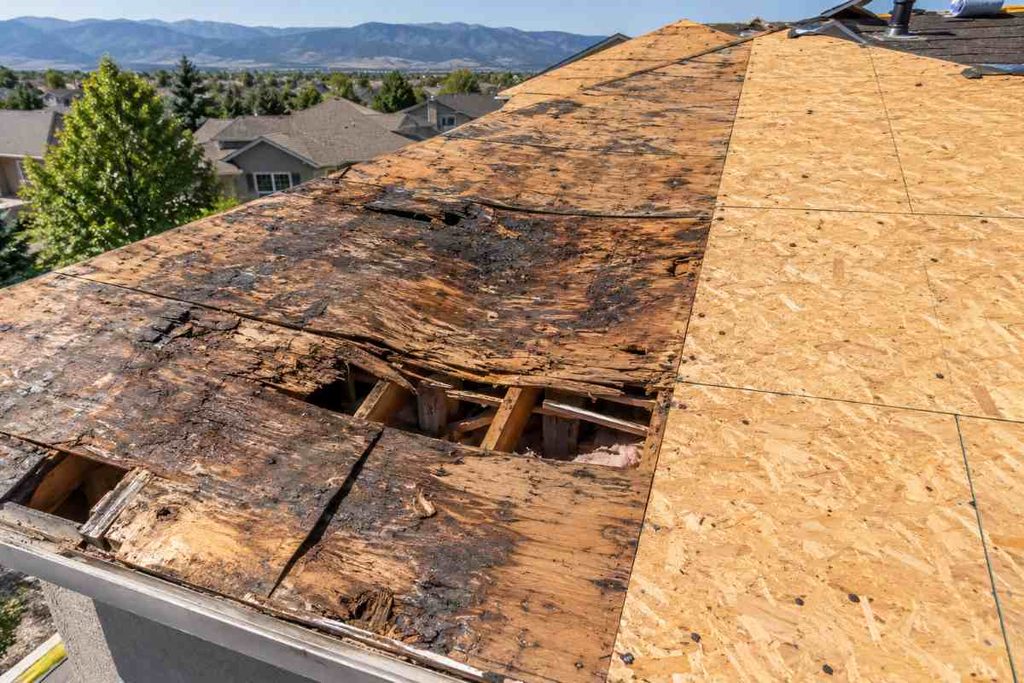
Deck damage forces a tear-off wherever the sheathing is soft, delaminated, or rotted, because a fastener will not hold in failed wood. The roof deck is the layer of plywood or OSB sheathing nailed across the rafters beneath the shingles.
Damage under a single slope can be handled as a section tear-off. Damage across multiple slopes moves the job to a full replacement. Either way, only the sheets that have failed get replaced.
Removing the old covering is the only time the deck gets seen. A replacement strips the roof to the sheathing, which is where soft spots, sagging between rafters, and delaminated or rotted sheets show themselves. A recover leaves all of that sealed underneath, undiagnosed. A sound deck has to be confirmed before new covering goes down, under the same 2024 International Residential Code rule that sends a replacement to the deck.
No building code sets a deck-damage percentage that tips a repair into a replacement. The call is condition-based. Sheathing that holds a fastener stays, and sheathing that is soft, sagging, or delaminated comes out. A bad sheet gives itself away underfoot, flexing under a boot where sound deck stays firm, and that is the sheet that gets cut out and replaced.
How Old Is Too Old to Repair a Roof?
A roof stays a repair candidate while meaningful service life remains and becomes a replacement candidate as it nears the end of its material’s rated life. InterNACHI’s Standard Estimated Life Expectancy Chart puts that at about 20 years for 3-tab asphalt, 30 years for architectural asphalt, and 100-plus years for clay or concrete tile.
The table sets each common material against its rated life and the repair scope that still fits near the end of it.
| Material | Estimated Service Life (InterNACHI) | Front Range Wear Factor | Repair Scope That Still Makes Sense |
|---|---|---|---|
| 3-tab asphalt | 20 years | Hail, high-altitude UV, and freeze-thaw cycling shorten it | Spot repair early; little worth spending late |
| Architectural asphalt | 30 years | Same factors shorten it; the heavier mat takes hail better than 3-tab | Slope or section repair through mid-life |
| Metal | Galvanized steel and aluminum 50-plus; copper 100-plus (InterNACHI, by type) | Fastener and panel movement from temperature swings | Reseal and refasten; panel-level repair |
| Clay or concrete tile | 100-plus years | Tile cracks under hail and heavy snow; the underlayment ages first | Lift and relay over new underlayment |
| Wood | 30 years | UV and freeze-thaw drive checking and curling | Individual shake or shingle replacement |
The age-position call compares a documented install date against that rated life. A permit record or an install invoice fixes the date. That beats guessing from how the roof looks. Douglass Colony, writing for aging commercial roofs, puts the point where repeated repairs stop paying off at 70 to 80 percent of service life.
That benchmark comes from commercial practice, not a residential standard.
Tile is the exception to reading age off the covering. The tile itself can outlast the house, but the underlayment beneath it does not, so the age clock runs on the underlayment. That is why the repair-scale option for tile is a lift and relay: a crew removes the tiles, replaces the worn underlayment, and relays the same tiles. The covering survives while the layer that actually fails gets renewed.
How Much Roof Damage Justifies Full Replacement?
Replace when damage covers roughly 30 percent or more of the covering or spans several slopes. Repair when it is isolated and the shingles still match. The 30 percent mark is a rule of thumb. It is not code.
Isolated damage is the clearest repair case. A single slope with a cluster of missing shingles, a failed pipe boot, a damaged valley, or worn flashing is a targeted fix, not a reason to replace the whole roof. Slope replacement is the middle scope, redoing one plane rather than the building. Its real limit is matching: new shingles against a sun-faded roof rarely blend, and a discontinued line can make a clean match impossible.
Past roughly 30 percent of the covering damaged, patchwork stops making sense. A roof repaired in large sections becomes a mixed-age system, new material sitting beside worn material with more seams where the two meet. Each of those junctions is a future failure point.
That reasoning is the whole basis of the rule, judgment from field practice rather than a line in any code. Where a parcel falls under the wildfire code’s 25 percent trigger, that mandatory threshold decides first, and the 30 percent guideline never overrides it.
Is It Cheaper to Repair or Replace a Roof Long Term?
Divide the repair cost by the years of service it realistically adds. Then divide the replacement cost by the new covering’s rated life. The lower cost per year wins. A repair near the end of a roof’s life has the fewest years to divide into.
Take an illustration. Angi puts a Denver roof replacement at about $11,712 on average, with most jobs between $7,419 and $16,461, or roughly $4 to $11 per square foot. Spread that $11,712 across the 30-year life InterNACHI gives architectural asphalt and it is about $390 a year.
Say a $2,500 repair buys three more years on a worn roof: that runs over $800 a year. A second repair two years later pushes it higher. That is the crossover: once a repair buys only a few years, its cost per year passes a new roof’s.
Some costs land only at replacement. A repair quote never carries them. A tear-off can expose rotted decking that has to be replaced before new covering goes on, and old extra layers have to come off. Ventilation problems get corrected, and code items get added that a patch never triggered.
One of those code items is the drip edge. Under 2024 IRC R905.2.8.5, asphalt shingle roofs need metal drip edge at the eaves and rake edges, which a replacement installs and a spot repair usually leaves alone. Budget these replacement-only items before setting a repair quote against a replacement quote, because the two are not covering the same scope.
How Does Insurance Change the Repair or Replace Decision?
On a covered storm claim, the adjuster’s approved scope sets what the policy pays. The owner covers the difference for any larger scope, and the deductible stays the owner’s cost. Under C.R.S. 6-22-105, a roofing contractor paid from insurance proceeds may not advertise or promise to pay, waive, or rebate that deductible. Waiting for a state grant is not a plan yet.
The funded scope comes from the adjuster’s inspection. The contractor does not set it. When the approved scope is a repair but the roof’s condition points to replacement, documented damage on each slope is what supports asking for a reinspection. Photographs of per-slope damage carry that request further than a general dispute does.
Hail damage is one common trigger for this gap, and it runs on its own claim path worth reading separately.
The deductible rule has teeth. Under the same statute, an insurer does not have to consider an estimate from a contractor who advertised a deductible giveaway, and the homeowner or the insurer can sue that contractor. A quote that offers to “cover your deductible” is a signal to walk, not a deal. The coverage decision stays with the insurer, measured against the policy and the documented loss.
Replacement opens one upgrade a repair cannot. A UL 2218 Class 4 shingle, the highest impact rating, is tested by dropping a two-inch steel ball from twenty feet and checking the mat for cracks. That is an impact rating, not a fire rating.
The Class A rating the wildfire code requires is a separate fire test. Passing one does not mean passing the other. An owner on a mapped Castle Rock parcel needs a product that carries both on its data sheet. Insurer discounts for Class 4 are voluntary, so get the figure in writing.
State help is coming, but not yet. SB26-155, signed June 4, 2026, created the Strengthen Colorado Homes Enterprise inside the Colorado Division of Insurance to fund hail and wind roof retrofits. It draws a fee of 0.5 percent of insurers’ homeowners premiums starting in 2027, with at least 85 percent of that revenue going to homeowner grants. Grant amounts and eligibility are not published yet, so treat the grant as unavailable when you decide today.
Should a Commercial Flat Roof Be Coated, Repaired, or Replaced?
Coat a flat or low-slope commercial roof when the membrane is dry, still attached, and within its service life. Repair when the failure is localized. Re-roof when failure spans a large share of the roof, the insulation under it is wet, or the roof already carries two coverings. The code bars any recover on that last one.
| Scope | When It Fits | When It Is Ruled Out | Code Basis |
|---|---|---|---|
| Coating | Membrane dry, bonded, and within service life | Wet insulation, or a second covering already in place | Treated as a recover under 2024 IBC 1512.3 |
| Repair | Failure confined to a seam, flashing, or puncture | Failure spread across roughly 25 to 30 percent of the area | No recover trigger; condition-based |
| Re-roof | Widespread membrane failure or wet insulation | Deck or structure needs separate work first | Recover barred when the roof is water-soaked, deteriorated, or doubled |
Membrane service life is not settled. The two common sources disagree enough to matter. Douglass Colony puts TPO and EPDM at 20 to 30 years and modified bitumen at 20 to 25. InterNACHI runs lower, listing TPO at 7 to 20 years, EPDM at 15 to 25, modified bitumen at 20, and built-up roofing at 30.
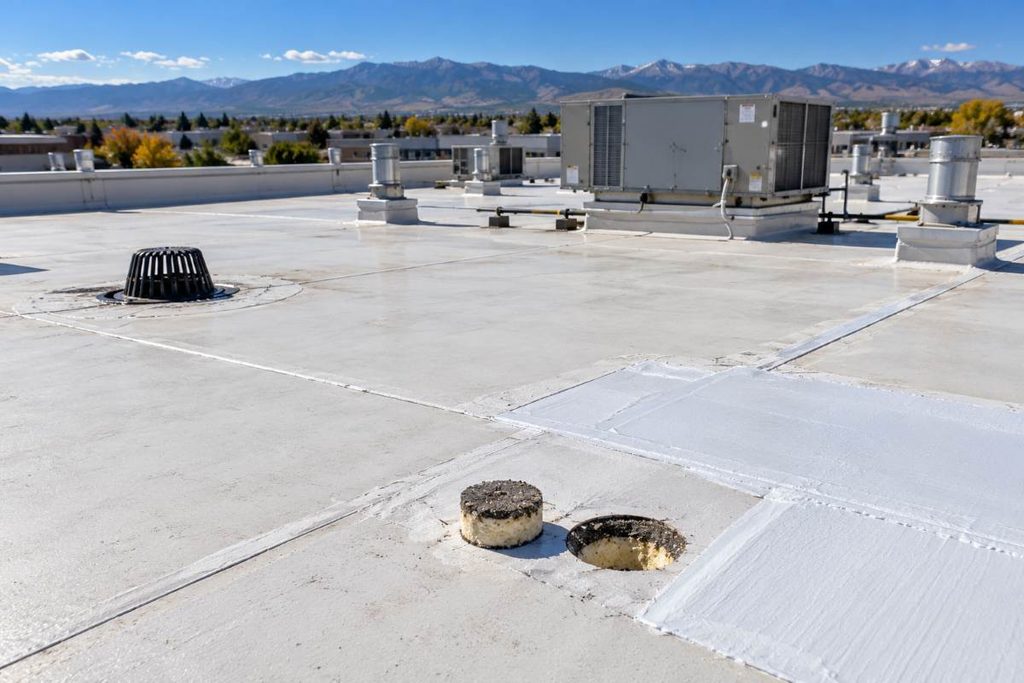
Under the 2024 IBC, which Castle Rock applies to commercial re-roof permits, laying a new coating over an existing roof counts as a roof recover. Section 1512.3 bars a recover where the existing roof is water-soaked or deteriorated, is slate or tile, or already carries two coverings.
That is why a coating decision starts with a moisture check. An infrared survey or a core cut, a small test plug pulled from the assembly, finds trapped water before anything seals it in. Only once the membrane reads dry does the coating chemistry get matched to the substrate.
The match matters because the coating has to bond to what is already there. Silicone, acrylic, polyurethane, and elastomeric coatings each suit different surfaces: a single-ply membrane, modified bitumen, metal, BUR, or SPF.
BUR is built-up roofing, the layered asphalt-and-felt system on many older flat roofs. SPF is sprayed polyurethane foam, a seamless roof applied as a liquid. A coating on wet insulation or the wrong substrate peels. Then the money is gone.
What Should a Roof Inspection Prove Before You Decide?
A trustworthy repair-or-replace recommendation documents five findings, each tied to a test earlier in this guide: the install date, the layer count, the percentage of covering damaged on each slope, the deck condition, and the parcel’s wildfire-code classification. Under C.R.S. 6-22-103, the contract that follows must then put scope, materials, approximate dates, and approximate cost in writing before any work starts.
Three of those findings settle code and age questions a quote cannot skip:
- The install date, from the permit record, tests the roof’s age against its rated life.
- The layer count, read at the eave, tests the two-layer limit that bars a recover.
- The parcel’s classification on the wildfire-intensity map tests the 25 percent re-roof trigger.
Photographs, drone footage included, turn each finding into evidence a claim or a reinspection request can actually use. An undocumented finding is an opinion; a photographed one is a record.
The condition findings set the contract scope. The damage percentage on each slope tests the 30 and 25 percent thresholds, and the deck and attic findings, soft spots, daylight through the boards, and water staining, test the structure underneath. Those results decide what the contract has to cover.
That contract, in writing and signed, must then carry the terms C.R.S. 6-22-103 sets out:
- the scope of roofing services and the materials;
- the approximate dates of service;
- the approximate cost, based on the damage known at signing;
- the contractor’s physical address, email, and phone, plus the surety and liability insurer;
- a cancellation policy with a full deposit refund if the owner rescinds within 72 hours of signing;
- a written statement of the separate right, under C.R.S. 6-22-104, to rescind within 72 hours of a written insurance claim denial;
- a statement that the contractor cannot waive or pay any part of the insurance deductible.
One term the statute puts in bold on the contract’s face: the contractor holds any payment in trust until materials reach the site or most of the work is done. Read that line before signing. It is the owner’s protection against paying for a job that never starts.

Recent Comments