
A Class 4 impact-resistant asphalt shingle is one built to pass the top tier of the UL 2218 test, a 2-inch steel ball dropped from 20 feet, calibrated to roughly the size of hail the Front Range actually produces. Standard shingles come in two common profiles, 3-tab and architectural. Neither profile is impact-rated on its own.
The difference shows up under hail. Colorado’s Front Range sits in the heart of Hail Alley, the zone that sees the highest frequency of large hail in North America. That exposure is what makes the upgrade question real for homeowners here rather than academic.
Class 4 shingles cost more than standard asphalt, so the decision comes down to whether the added performance earns back its price.
Passing the lab test is a floor, not a lifespan guarantee. A Class 4 asphalt roof still sheds granules and ages under repeated hail even while it keeps passing, so the real question this page works through is how much service life and insurance benefit the upgrade buys back against its cost.
How Are Asphalt Shingles Rated for Impact Resistance?
Asphalt shingle impact resistance is graded by the ANSI/UL 2218 steel-ball test on a Class 1 through 4 scale, with Class 4 as the top tier. The sections below define a Class 4 shingle, clear up the architectural-versus-Class-4 confusion, and explain what each grade covers.
What Is a UL 2218 Class 4 Impact-Resistant Shingle?
A Class 4 shingle is one that passes the ANSI/UL 2218 impact test at its highest level, showing no crack or rupture on the back surface after a 2-inch steel ball is dropped on it twice in the same spot from 20 feet. It earns that rating through a polymer-modified asphalt mat, made with SBS, a synthetic rubber blended into the asphalt. That rubberized mat flexes on impact instead of fracturing.
Standard asphalt behaves differently under the same strike. Its unmodified asphalt is stiffer and more brittle, so a hard hit cracks or splits the mat rather than absorbing it. The test measures one thing that matters on a real roof: whether the covering stays watertight after impact, or opens a path for water.
Are Architectural Shingles the Same as Class 4?
No. Architectural, or dimensional, describes a shingle’s profile and layered construction, not its impact rating, and a shingle can look thick and high-end while carrying no impact class at all.
Profile and impact class are set separately. An architectural shingle earns Class 4 only if that specific product passed the UL 2218 impact test at the top level. A standard architectural line is not Class 4 unless its data sheet says so.
To confirm it, read the UL 2218 Class printed on the product spec sheet or the bundle wrapper rather than judging by how the shingle looks.
What Do Shingle Impact Grades Class 1 Through 4 Mean?
UL 2218 rates shingles Class 1 through 4 by the size and drop height of the steel ball they withstand, from a 1.25-inch ball at 12 feet for Class 1 up to a 2-inch ball at 20 feet for Class 4, the highest. The scale lets you place Class 4 against the lower tiers rather than reading it in isolation.
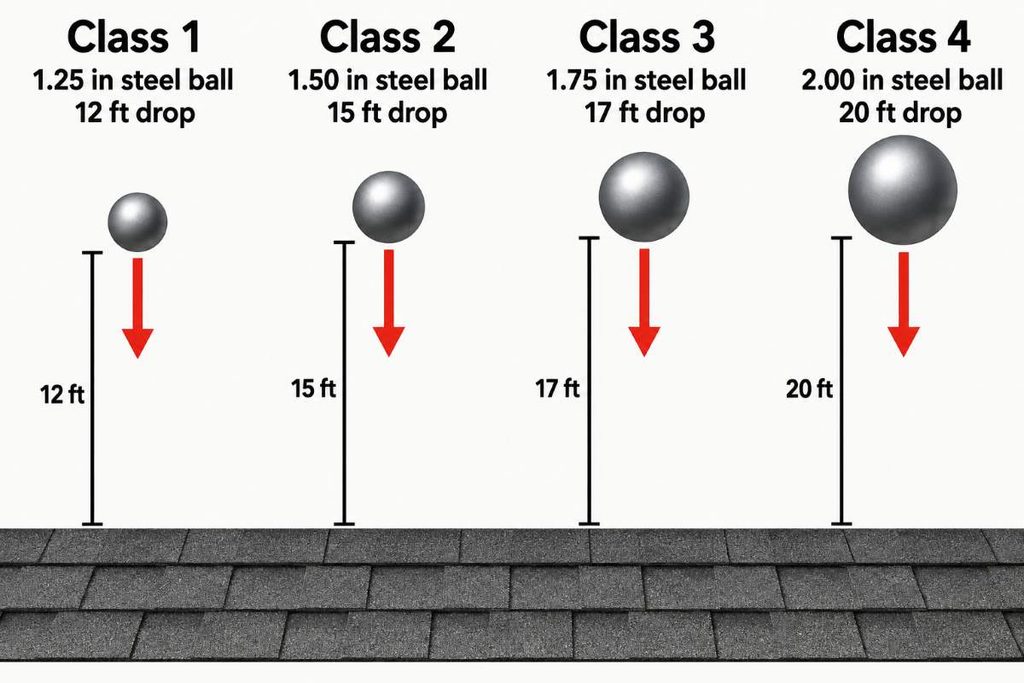
| Impact grade | Steel ball diameter | Drop height |
|---|---|---|
| Class 1 | 1.25 inches | 12 feet |
| Class 2 | 1.5 inches | 15 feet |
| Class 3 | 1.75 inches | 17 feet |
| Class 4 | 2 inches | 20 feet |
Some insurers reference a second test, FM 4473, “Specification Test Standard for Impact Resistance Testing of Rigid Roofing Materials by Impacting with Freezer Ice Balls.” It fires ice balls from an air cannon instead of dropping steel balls, and grades rigid materials like tile and slate on the same Class 1 through 4 scale.
How Do Class 4 and Standard Shingles Perform in Front Range Hail?
In Front Range hail, Class 4 shingles resist the cracking, mat fracture, and granule loss that damage standard 3-tab and architectural shingles, because the polymer-modified mat absorbs impact energy that would split a standard shingle. The table sets the two roofs side by side under the same strike.
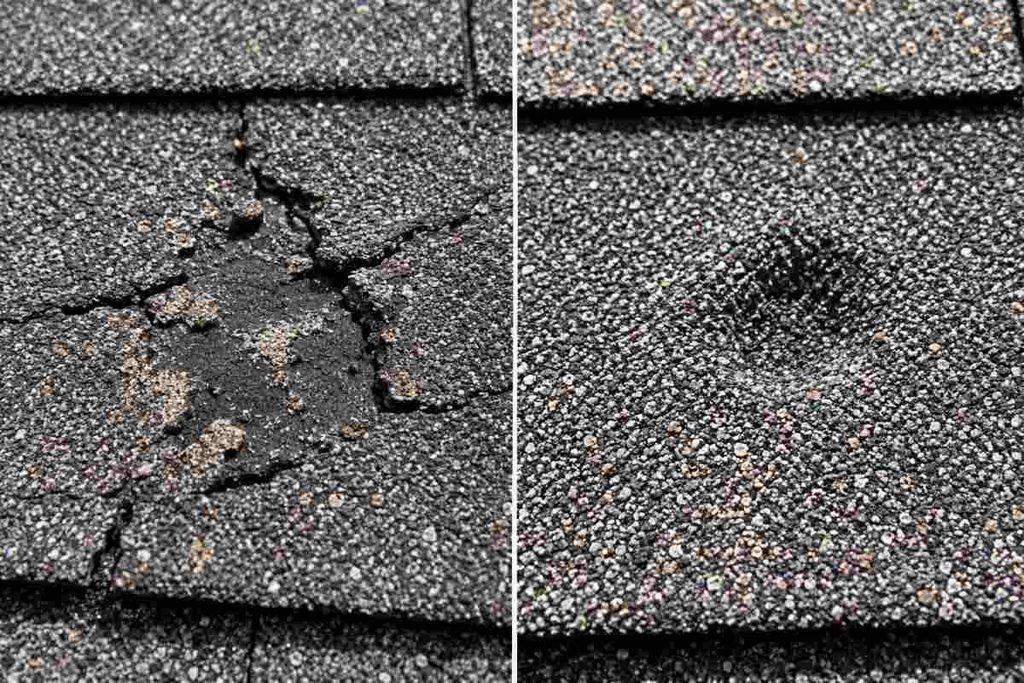
| Under hail impact | Standard 3-tab and architectural | Class 4 impact-resistant |
|---|---|---|
| Mat response | Cracks or fractures under a hard strike | Flexes and absorbs the energy |
| Surface granules | Knocked loose, exposing the asphalt | Held better, slower to bare the mat |
| Result on a real roof | Water paths open sooner, roof ages faster | Stays watertight longer after impact |
| Wind uplift | More prone to lifting at edges and tabs | Reinforced construction resists uplift |
Front Range hail regularly reaches the size the Class 4 test is built around. NOAA’s Storm Events Database records hail of 2 inches and larger across Douglas, Arapahoe, and Jefferson Counties. A May 2017 Denver metro storm ran past 2.5 inches and damaged tens of thousands of roofs. That is the diameter the top test simulates.
Hail is not a side risk to a Colorado roof budget. The Colorado Division of Insurance found hail is the number one cost driver of homeowners insurance rates statewide, accounting for 26 to 54 percent of an annual premium depending on the county. On a roof that faces that exposure, the gap between a shingle that keeps shedding water and one that cracks is the gap the upgrade is paying to close.
What Does Upgrading From Standard to Class 4 Cost?
Class 4 costs more than standard asphalt, and nearly all of the difference sits in the material, because the two roofs install the same way and carry the same labor, which in the current Denver-metro market puts the material premium in the low thousands on a typical home. The table separates the material delta from the total installed job so the ranges make sense together.
| Cost measure | Standard architectural | Class 4 impact-resistant |
|---|---|---|
| Material, per square (100 sq ft) | $110 to $165 | $150 to $325 (mid-tier to premium SBS) |
| Labor, per square | Same install, same labor | Same install, same labor |
| Installed, per square | $450 to $600 | $550 to $750 |
| Material premium, typical home | reference point | about $1,000 to $1,500 added |
| Your quote | varies by roof size, pitch, access, and product line | varies by roof size, pitch, access, and product line |
Roof size sets the base. Complexity moves it from there: a steep pitch, multiple valleys, dormers, or hard crew access all raise the per-square labor on any roof, standard or Class 4 alike. A complex roof costs more in both columns rather than widening the gap. Product tier is the other lever, since a mid-tier Class 4 line and a premium SBS-modified one can sit a few hundred dollars per square apart.
The upgrade premium is mostly material, not labor. That is why the honest answer to how much more is a range, not a single number: the same house can quote differently depending on which Class 4 product goes on and how the roof is shaped. Read a quote material tier first, and you see where the premium comes from.
When Does the Class 4 Upgrade Pay Off?
The Class 4 upgrade pays off when the savings it produces recover the upgrade premium within the years a homeowner expects to keep the house. Those savings come from three places. An insurance mitigation credit where a carrier offers one, the hail-claim costs and deductibles avoided when a stronger roof rides out a storm, and the longer service life of the shingle. In the Front Range hail belt, that window is often short.
The math is a simple division: take the upgrade premium, divide it by the annual savings, and the result is the number of years to break even. A homeowner staying past that point comes out ahead. One who sells before it may not, which is why the same upgrade pays off for one owner and not another.
Colorado does not have a law that forces insurers to give a flat discount for a Class 4 roof. Many carriers still offer a mitigation credit, priced to their own claims data, because impact-resistant roofs file fewer hail claims. The credit varies by carrier and policy. The figure that matters for a break-even estimate is the one a homeowner’s own insurer will put in writing.
State policy is shifting the ground under that credit. A 2026 law created the Strengthen Colorado Homes Enterprise, a grant program that will fund resilient-roof retrofits for homeowners, with at least 85 percent of its revenue going to those grants. It is funded by a 0.5 percent insurer fee starting in 2027, and carriers may not pass that fee to policyholders as a surcharge.
The same law begins requiring insurers to show in their rate filings that resilient-roof savings actually reach homeowners. Carrier-specific credit amounts and the paperwork each one wants are covered separately.
Do Class 4 Shingles Last Longer Than Standard Shingles?
Class 4 shingles generally carry a longer functional life than standard asphalt, often 30 years or more against 20 to 25 for a standard roof. The reason is the reinforced, SBS-modified mat. It sheds granules and cracks more slowly, and granule loss and cracking are what age an asphalt roof. In a hail climate, that difference compounds, because a standard roof often takes a storm hit that ends its life before its rated years.
Longer functional life is not the same as a longer guarantee, though. Warranty coverage is a separate question, and it is where the impact rating gets misread most often.
A Class 4 rating is not a hail warranty. The rating means the shingle passed the UL 2218 lab test, not that a manufacturer promises it will survive a real storm undamaged. Manufacturer limited warranties run long on paper, often 30 years to lifetime, but “lifetime” means the manufacturer’s defined product life, and most coverage is prorated, so the payout shrinks as the roof ages.
The sharper distinction is functional versus cosmetic. Class 4 shingles resist the functional damage that lets water in, but they can still take cosmetic marks in a hard storm. If a homeowner’s policy carries a cosmetic damage exclusion, those surface marks may not be covered no matter how widespread they are. The rating governs how the shingle performs. The policy governs what gets paid, and the two are not the same thing.
Is the Class 4 Upgrade Worth It for a Front Range Home?
For most Front Range homeowners staying in the home more than a few years, the upgrade is worth it, because hail exposure and the mitigation credit shorten the payback. For a short-tenure owner in a lower-hail micro-area on a tight budget, a quality standard architectural roof can still be the rational choice. The specifics decide it, not a blanket rule.
The upgrade clearly pays off when:
- Tenure is long enough to pass the break-even point, so the annual savings outrun the premium.
- The home carries a high wind and hail premium that a mitigation credit can meaningfully cut.
- The address sits in a high-exposure part of the hail belt, where a 2-inch storm is a question of when.
Standard architectural can still be the rational call when:
- The owner expects to sell before the break-even year arrives.
- Budget is tight and the local micro-area sees lower hail frequency than the corridor average.
- A re-roof is already happening, in which case metal or synthetic impact-resistant systems are worth pricing against Class 4 asphalt before defaulting to either.
The honest answer is conditional, not universal. Run the break-even against your own tenure, your own carrier’s credit, and your own corner of the hail belt, and the roof that wins is the one whose numbers close inside the years you will own the house.

Recent Comments